
On July 17, the 2026 World Artificial Intelligence Conference (WAIC 2026) officially opened. At the event, INSIDE Institute for NeuroAI (INSIDE) made its first comprehensive showcase, presenting its full-stack innovation roadmap across multimodal brain signal foundation model, scientist-led research collaborations, and next-generation brain-controlled interaction applications.
The showcase marks a major milestone in INSIDE’s strategic roadmap — establishing a closed-loop innovation ecosystem spanning research-industry collaboration, foundational model development, and consumer-oriented applications. By connecting cutting-edge brain science research with scalable commercial deployment, INSIDE is accelerating the evolution of brain-computer interfaces (BCI) from scientific innovation into a large-scale industrial ecosystem.
From the highly popular “mind-controlled AAA game” demonstration zone to advanced research on digital therapeutics for tinnitus addressing real clinical challenges, INSIDE delivered a clear message at WAIC 2026: brain-computer interfaces (BCI) are no longer limited to laboratory demonstrations. The technology is rapidly crossing the commercialization gap, becoming a new generation of intelligent interfaces that are visible, tangible, and ready for real-world adoption.
Activating the Source of Innovation: A Research-to-Industry Incubation Platform Empowered by Leading Scientists
The first step toward building a complete innovation ecosystem is unlocking the potential of cutting-edge research.
For decades, many breakthroughs in neuroscience have remained within academic institutions, with challenges in transforming scientific discoveries into practical applications. Bridging the gap between fundamental exploration and commercial deployment has become a shared challenge across the industry.
At WAIC 2026, INSIDE officially unveiled its key innovation engine for technology commercialization — the Research-to-Industry Innovation Incubation Platform.
The platform aims to become a global value creator and ecosystem driver for BCI commercialization. By deeply connecting world-class scientific research teams with mature industrial resources, it establishes a sustainable innovation pipeline through technology transfer, industrial incubation, resource integration, and two-way collaboration.
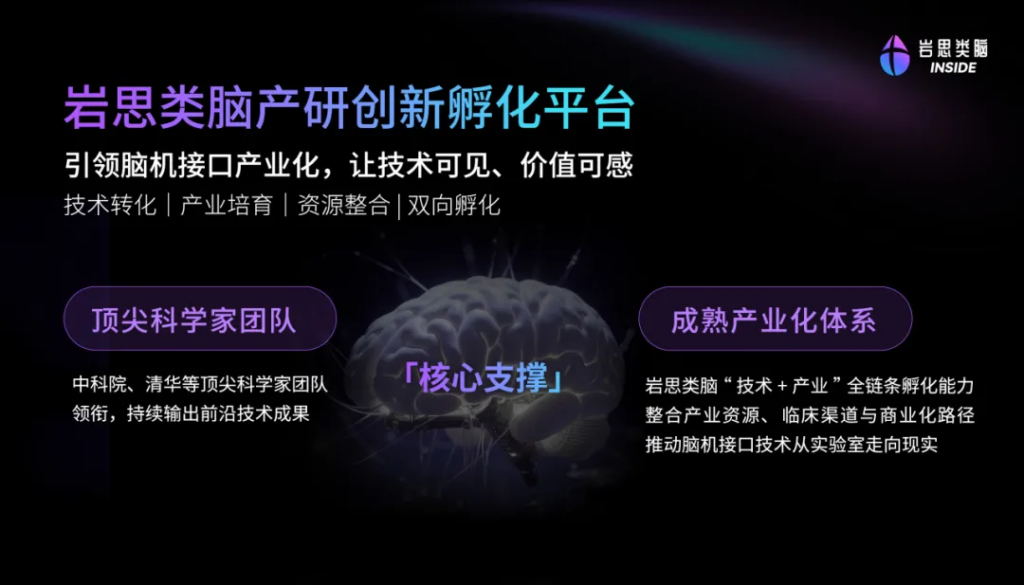
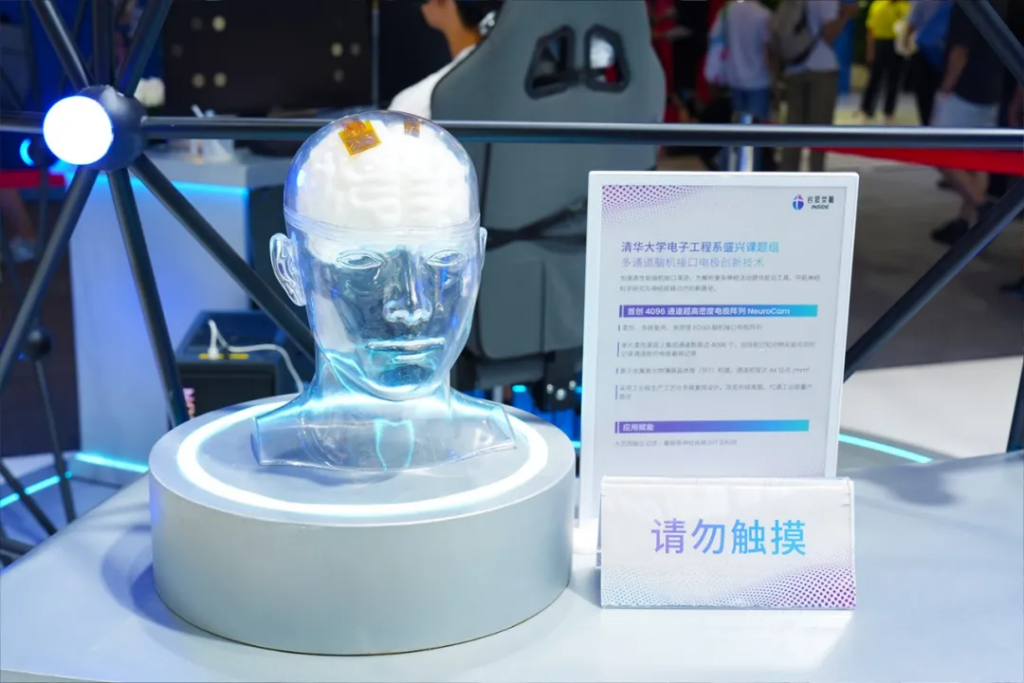
At the exhibition, INSIDE showcased several initial collaborative projects, including the Brain-inspired Foundation Model and Neural Simulation Platform led by Professor Guoqi Li, Director of the Beijing Key Laboratory of General Brain-inspired Intelligence Large Models, as well as the multi-channel brain-computer interface electrode innovation technology developed by the Sheng Xing’s Research Group from the Department of Electronic Engineering at Tsinghua University.
From the beginning, these projects have been designed with commercialization in mind, closely aligned with clinical needs and market demands, featuring clear technology transfer pathways and strong commercial potential.
Among them, the NeuroCam 4096-channel ultra-high-density electrode array developed by Professor Sheng Xing’s team represents a significant breakthrough. It is currently one of the highest-channel-count electrode arrays known to simultaneously record neural signals in animal studies. The technology addresses major limitations of existing BCI electrode systems, including insufficient channel numbers, low density, complex wiring, and manufacturing challenges, opening new possibilities for high-resolution large-scale neural signal recording.
Leveraging INSIDE’s integrated capabilities across technology development and industrial commercialization, the incubation platform will bring together industry resources, clinical networks, and commercial expertise to transform China’s leading brain science innovations into practical solutions addressing real-world challenges.
This synergy between world-class scientific intelligence and industrial acceleration will serve as a key driver for INSIDE’s continued leadership in the BCI industry.
Building the Foundational Intelligence Layer: Multimodal Brain Signal Foundation Model Advances Digital Twin Brain Applications
While research-industry collaboration provides the driving force for innovation, foundation models serve as the critical infrastructure enabling BCI technology to evolve toward greater scalability and generalization.
As an early mover in the field, INSIDE Institute for NeuroAI began developing its brain signal foundation model in 2023. Through multiple rounds of technological iteration, INSIDE has focused on proprietary neural decoding algorithms and successfully developed a groundbreaking multimodal brain signal foundation model.
Built around unified neural representations, the model deeply integrates both invasive and non-invasive neural signals to create a predictable, simulatable, and continuously optimized “digital twin brain.” This foundational intelligence layer provides general-purpose support for a wide range of applications, including neural function restoration, neurological rehabilitation, closed-loop neural regulation, and intelligent brain-controlled interaction.
In the field of advanced medical applications, the potential of this foundational model is now being explored in medical research. Leveraging its brain signal foundation model, INSIDE is accelerating research into digital twin brain-based closed-loop neural regulation systems. By enabling an integrated cycle of brain signal acquisition, intervention simulation, response prediction, and parameter optimization, the system aims to better adapt neural regulation technologies to real-world clinical scenarios and provide more personalized and precise intervention solutions for challenging conditions such as tinnitus.
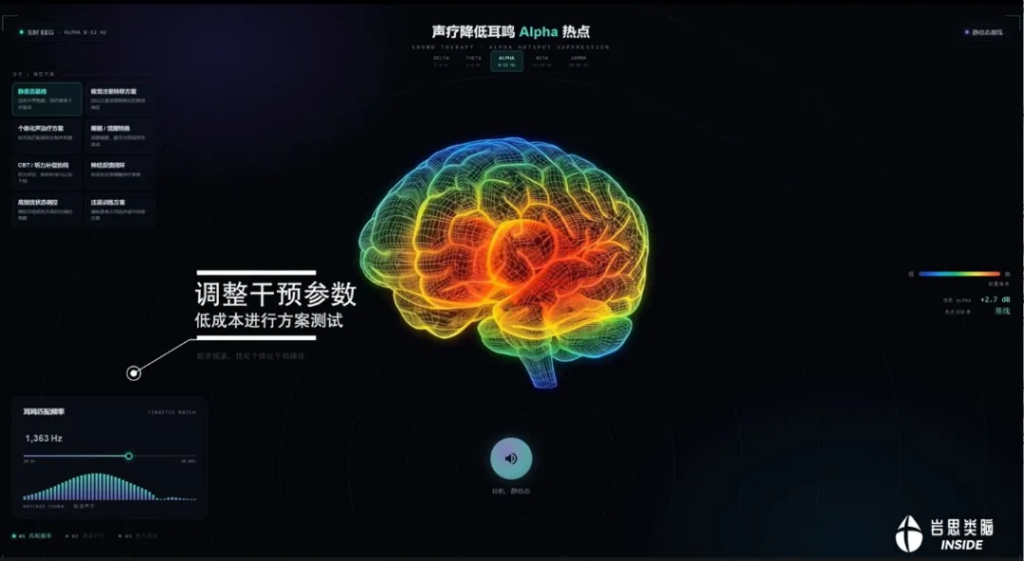
From a general-purpose intelligence foundation empowering the broader industry to precision solutions serving individual patients, INSIDE is transforming BCI technology into a new form of “digital medicine.”
By overcoming traditional limitations in scalability, real-time adaptation, and individual variability, INSIDE demonstrates the significant commercial and social potential of combining AI with brain science to advance accessible healthcare.
Unlocking Consumer Applications: Ultra-Integrated Brain-Controlled Terminal with a 1% Form Factor Makes Debut, LumiSleep Begins Pre-Sales
Beyond specialized applications, the continued maturation of foundational technologies is accelerating the adoption of BCI in consumer markets.
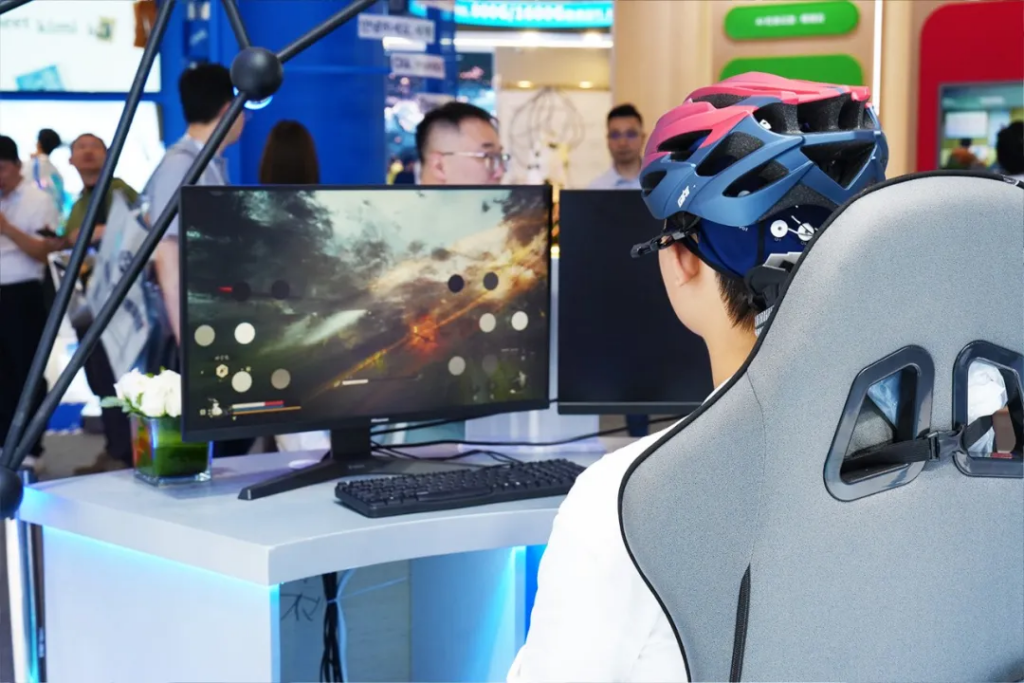
At WAIC 2026, INSIDE’s demonstration of mind-controlled gameplay featuring the AAA game “Black Myth: Wukong” became one of the most talked-about highlights of the exhibition.
Behind this immersive interaction experience was INSIDE’s self-developed next-generation brain-controlled gaming interaction system. Featuring an ultra-highly integrated design, the system combines advanced BCI algorithms with high-precision neural signal reconstruction technology, powered by a miniaturized hardware architecture designed for the next generation of accurate, portable, and personalized brain-controlled devices.
The new system breaks through the traditional limitations of bulky BCI hardware. By achieving a dramatic reduction in size and weight while maintaining high-performance capabilities, it delivers comparable brain-control interaction performance within just 1% of the volume of traditional leading solutions.
During the demonstration, player visually evoked neural responses were decoded in real time, allowing them to control in-game actions without physical input. The experience brought the concept of “thought-driven interaction” from science fiction closer to reality.
This breakthrough in hardware miniaturization and system integration represents a critical step toward bringing BCI technology into mainstream consumer markets.
Meanwhile, INSIDE’s neurotechnology innovation brand LumiMind also unveiled its first consumer product — LumiSleep, a real-time brainwave-regulated sleep device — and officially opened pre-orders at the event. The product is expected to launch in the second half of 2026.
LumiSleep introduces millisecond-level real-time EEG closed-loop regulation technology into consumer sleep applications for the first time. Through localized advanced algorithms, the device accurately detects changes in brain states and provides users with scientifically driven, efficient, and personalized sleep solutions.
The launch marks a new milestone in INSIDE’s strategy of rapidly transferring core technologies into consumer products and developing scalable intelligent devices for everyday life.
Under the spotlight of WAIC 2026, INSIDE Institute for NeuroAI demonstrated its transformation from a company focused on individual technological breakthroughs into an architect of a broader BCI industry ecosystem.
The showcase not only further strengthened INSIDE’s early leadership position in the brain-computer interface sector but also highlighted a practical pathway toward large-scale commercialization through technologies that deliver visible innovation and tangible value.
With continued investment in research collaboration, foundational models, and consumer applications, INSIDE is accelerating the arrival of a future where brain-controlled interaction becomes part of everyday life.
The era of accessible brain-controlled intelligence is coming faster than ever.